













Biotechnologies Group scaled Dot Ingredients' wood-pulp surfactant from a few grams to kilogram batches – and took two years off its path to profitability.
In June 2025, every gram of Dot Ingredients’ unique product was precious. Over two days, the company’s lab could make five grams of Naturdots™, a new cellulose-based ingredient for skincare and other products that helps oil- and water-based ingredients mix more effectively.
But by December, after working with the Biotechnologies Group to scale up production, they had more product than they knew what to do with, says Dot Ingredients CEO and co-founder Dr Michael Fielding. “Before, we had to justify what we did with every gram. After the Biotechnologies Group made a one kilogram run, the question became, do we actually have more than we can handle? Will they start to biodegrade faster than we can use them?”
It wasn’t a problem for long. Dot’s team stopped making particles and started testing and optimising them, sending samples to companies here and overseas. “It accelerated our commercial engagement,” says Fielding. “We could focus on the next steps; using the particles, instead of making them.”
Most importantly, it cut two years off the timeline to first revenue. “We had planned on raising more investment to get to one-kilogram scale – and that would still not be commercially viable. Now, with that milestone already ticked off, our current Seed round will get us to the point where we can make batches for real end-users,” says Fielding.
“For investors, that means we'll get to profitability two years earlier.”
What exactly are Naturdots?
Naturdots™ are made by physically rearranging cellulose from wood pulp into tiny spheres of around 0.2 microns (a human hair is 500 times wider). When combined with a tiny amount of normal soap, they create surfactant or emulsifier particles that reduce the surface tension between ingredients, so they blend to create stable products that don’t separate.
Naturdots™ are different from typical surfactants and emulsifiers in two ways. They are particles, not molecules, which means they’re larger and less likely to penetrate the skin in personal care products. And they’re made from wood pulp, a plentiful and biodegradable waste product, unlike the fossil fuels and palm oil that 95% of surfactants are made from.
Dot Ingredients’ proprietary chemistry process produces virtually no waste and is almost a completely closed loop – but during production, the billions of tiny particles float around in a large amount of water, and the Dot Ingredients lab couldn’t accommodate the volume required to scale up production.
How the Biotechnologies Group helped
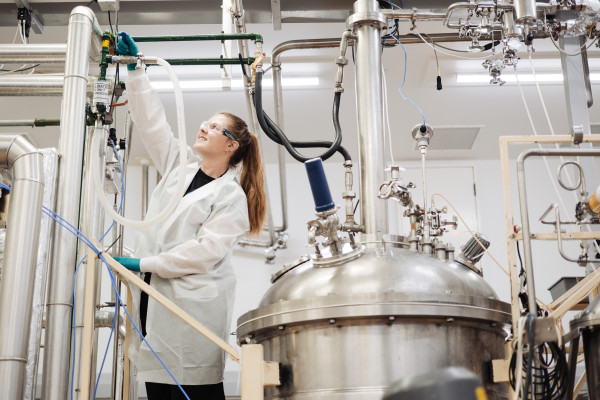
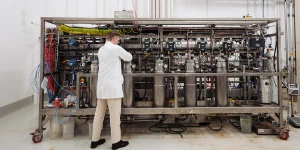
Dot Ingredients turned to the Biotechnologies Group for the large-scale filtration and separation needed to scale production from five grams to a kilogram, a 200-fold jump. The team scaled to 100-gram runs between June and July 2025, and to a kilogram by December – a six-month process that Dot Ingredients didn’t expect to work so rapidly. “Finding out that we have this capability here in New Zealand was like, ‘Hallelujah’,” recalls Fielding. “We wouldn’t have got this far so fast without those facilities. We'd still be making 10- or 20-gram batches, instead of knowing with absolute confidence that a kilogram can be made in one go.”
“When people talk about science infrastructure, it's not just high-performance computing clusters and multimillion-dollar electron microscopes. Materials companies like us need pilot-scale equipment that is there ready to be scheduled, to de-risk production and scale up,” says Fielding. “Each bit of kit is not massively expensive on its own, but when they each have multi-month lead times and you aren’t 100% sure they’re right for the job, the risks and costs go up enormously. That’s why shared, national facilities are vital.”
It’s also about the people. A key contact for Dot Ingredients is Peter Dyer, senior principal engineer at the Biotechnologies Group. “Peter shares our passion and energy,” says Fielding. “He’s very experienced, super responsive, and quickly turns work around.”
The technical scale-up advice the team has received from the Biotechnologies Group has also accelerated their process engineering. “Most of our team’s experience is in a lab,” explains Fielding. “The Biotechnologies Group has been able to show us which processes that are hard in the lab, actually get easier and cheaper with scale.”
From pilot plant to global markets
About US$50 billion of surfactants are used in pharmaceuticals, cleaning detergents, cosmetics, paints, and industrial products every year. Dot Ingredients has its eyes on this prize.
The first market is cosmetic emulsifiers for makeup and skincare, a US$2 billion industry. Just five kilograms of Naturdots™ produced at Dot’s planned pilot plant will provide sufficient emulsifier for 1,000 litres of cosmetics. Given the range of potential applications, growth beyond that could go in several directions; one pathway is to lean into high-volume applications, like laundry products.
Dot Ingredients grew out of research at AUT's School of Science, first funded by the Royal Society (Catalyst Seeding) in 2017. In 2019, funding from the Science for Technological Innovation National Science Challenge allowed the key scientific discovery, foundational to Dot’s first patent application. Commercialisation support then came from AUT Ventures and the MacDiarmid Institute, followed by KiwiNet Tier 2 and MBIE funding. In 2025, the company raised its first investment of $350,000 from Motion Capital, Climate Venture Capital Fund, and the AUT Innovation Fund.
Now in 2026, with the days of rationing each gram of product behind them, what’s ahead is a new pilot plant, global markets, and the confidence that scale-up support for future projects remains on tap at the Biotechnologies Group.
Discover how our Biotechnology Group can support your goals
Get in touch today https://www.callaghaninnovation.govt.nz/products/solve/